
The Sequence 6/5-6/11
Breakthrough Analysis of Endometriosis, New Treatment for Lung Cancer, The Utility of Polygenic Risk Scores in Clinic, New Insights into Perspectives on Familial Genetic Testing

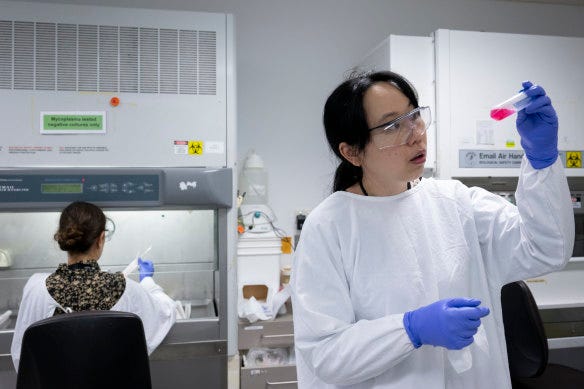
Dr Dongli Liu examines tissue grown from live endometriosis cells at the Lowy Cancer Research Centre, Sydney. Image credit: Brisbane Times
Breakthrough analysis of endometriosis
Endometriosis is a common condition affecting up to 10% of all women. Read on to see why a study led by a group of researchers in Sydney that grew tissue from every known type of endometriosis is so monumental.
Let’s back up. What is endometriosis?
Good question- endometriosis occurs when tissue similar to the uterine lining (aka the endometrium) attaches to organs in the pelvis and begins to grow.
Why does this happen? It’s not clear. But, we know that during the menstrual period, when most of the uterine lining and blood is shed, some of that tissue enters the pelvis through the fallopian tubes. So, it’s possible that those who develop endometriosis just can’t clear that tissue.
This excess tissue and irritation in the pelvis causes abdominal pain, heavy periods, bloating, bleeding from the bladder and bowel, tiredness, anxiety triggered by pain, and infertility. And, it increases the lifetime risk for ovarian cancer.
Got it. What did the analysis of endometriosis tissue find?
After analyzing 30 different lab-grown tissues taken from women with endometriosis during surgery and observing changes in the different types, the group was able to find how different types of endometriosis respond to different treatments.
This is huge. Right now, treatments for endometriosis include everything from simple lifestyle modifications like exercise and relaxation techniques to surgery, and all types of medication in-between. Utilizing this new data, healthcare providers will be able to vary treatments for different types of endometriosis, and even determine whether a woman will need fertility treatments.
What’s the takeaway?
It’s simple: all cases of endometriosis are not the same, so treatments of all cases of endometriosis shouldn’t be the same. The new information brought to light in this study will allow for the appropriate treatment of endometriosis based on the type. This means avoiding over-treatment and surgery that isn’t needed, and conversely, under-treatment of an aggressive form of endometriosis that could lead to infertility. Most importantly, this will allow affected women to feel relief earlier on in their journey.
Full article; resource: Endometriosis: A Guide for Patients

Image credit: American Lung Association Instagram
New treatment for lung cancer
AstraZeneca presented new data from a 682-patient trial, called ADAURA, at the American Society of Clinical Oncology (ASCO) meeting earlier this week. The new treatment targets a form of lung cancer called non small cell lung cancer (NSCLC), which can be associated with pathogenic variants in the EGFR gene.
Tell me about the EGFR gene.
EGFR codes a protein called epidermal growth factor receptor, which quite literally helps cells to grow and divide. A pathogenic variant, or a harmful change in the DNA, in this gene can cause overgrowth, leading to cancer. Current treatments include different types of drugs that inhibit EGFR.
Makes sense. How did the new treatment work?
Well! The drug, called Tagrisso, was shown to cut risk of death by 51% in patients given Tagrisso compared to those given a placebo. And, an estimated 88% of patients treated with Tagrisso were alive at five years compared to 78% on placebo. Patients selected for the trial had already undergone surgery to remove their primary tumor.
What’s the takeaway?
Given an estimated 2.2 million people are diagnosed with lung cancer globally each year, and 10-40% of those are lung cancers associated with EGFR, this treatment is important for many patients and families out there. Tagrisso is the first drug to extend lives of people with EGFR-associated lung cancer this long. Results from this study offer an invaluable resource for patients with lung cancer globally.
Full article; resource: American Lung Association
What is the utility of polygenic risk scores in clinic?
A polygenic risk score (PRS) is a number, or a ‘score’ that estimates an individual’s risk for a certain condition. They are used in conditions that are caused by changes in many genes, often coupled with environmental factors.
As we discover more genes that impact our health, PRS are being generated for everything. In this newsletter alone, I’ve covered the utility of PRS to predict breast cancer, colorectal cancer, prostate cancer (in men with African ancestry), glaucoma, and gestational diabetes. I’ve even covered the utility of PRS in predicting response to treatment in cases of leukemia.
In this article, covering a piece by the New York Times (NYT) and reported Gina Kolata, I discuss the practical utility of using PRS in clinic. How useful is it to order PRS in a clinical setting?
What can PRS tell us?
PRS tell us the likelihood of getting a certain condition. This piece by the NYT centers around a patient whose father and paternal grandmother both had heart attacks at age 53. When she found out she had high cholesterol at the young age of 34, it was only to natural to wonder whether she was beginning to follow the same path as her father and paternal grandmother: what is her risk of a heart attack? Should she start medication to lower her blood pressure now, at only 34 years old?
Given the young age of hearts attacks in multiple family members, it is fair to wonder if there is some sort of genetic influence on this patient’s high cholesterol, and whether that same genetic influence caused those young heart attacks. This is where PRS come in.
How accurate are they?
It’s hard to say. Plenty of data has shown that PRS are fairly accurate at distinguishing people at high risk vs. low risk of getting a condition (see any or all of those studied I’ve covered before), but there is not a lot of long-term data available. Dr. Sadiya Sana Khan of Northwestern University emphasized,
“We need more studies that focus on younger people with follow-up over several decades …if risk scores in young adults predict a greater likelihood of a heart attack, will that prediction be borne out when the people are older, at ages when heart attacks are more likely? Or will those with high risk scores instead be needlessly worried about their hearts?”
In part, these questions come from her own research experience. She has a new study showing that, in middle-aged to older adults, CT scans of the heart, which can show the buildup of plaque, are better than genetics in predicting risk.
On the other hand, another recent study that did just that and followed young people with high PRS scores over time in Britain and Japan found that those with higher PRS were in fact more likely to have a heart attack, but only if the people were younger than 50 years old. Beyond that, the risk was conflated with traditional risk factors; think smoking and diabetes.
What's the takeaway?
Although different physicians are currently utilizing PRS in different ways, with no agreed upon standard, Dr. Christa Martin, Geisinger’s chief scientific officer, predicts “We will treat it no differently than cholesterol screening or screening for diabetes.” At this point, I think it makes sense to utilize PRS as part of a holistic approach to medicine, while incorporating family history and traditional screening methods. If you’re considering the use of a PRS in your clinical care, you can always find a genetic counselor to speak to here.
Interested in reading more research on PRS? This article talks about the utility of PRS in diverticulitis, this one explores PRS screening models for eight different types of cancer, and this one discusses findings that coronary artery calcium scores are better than polygenic risk scores at predicting coronary heart disease.

Image credit: CDC
New insights into perspectives on familial genetic testing
Late last year, I introduced readers to a study looking at how the use of an animated digital message impacted the likelihood of a family member of someone just diagnosed with a genetic condition to pursue genetic testing. See more details on the study from that post here. Fast forward to this week, when Australian researchers reporting in the European Journal of Human Genetics looked at public perceptions of family member genetic testing.
Can you give me a recap of the original story?
The first study looked at questionnaire responses from 373 adults after they had watched an animated digital message (i.e. a video) conveying information about the meaning of test results from a hereditary breast and ovarian cancer (HBOC) syndrome test. The purpose was to understand the impacted participants’ likelihood to pursue genetic testing after watching the video. The result: most would get genetic testing.
What’s new about this study?
While the last study was looking at perspectives on genetic testing of a participant who was at-risk for a genetic condition after they watched an educational video, this study asked participants to think about whether they would want to know they were at-risk for a genetic condition in the first place so that they could consider genetic testing in general. No educational video provided. Importantly, this study was specifically asking about medically actionable genetic conditions (think: susceptibility to heart disease or cancer).
Of the 1,030 participants that responded to the survey, the team found that 85% of individuals said they would want to know if genetic variants linked to a treatable or preventable condition were detected in a family member, putting them at risk.
Interesting. What’s the takeaway?
It is! Together, both of these studies show that individuals at risk of developing an actionable genetic condition want to know. By identifying susceptibility to these conditions earlier, family member of patients who have tested positive for genetic conditions can receive the appropriate preventive health services. Overall, this reduces mortality and morbidity from these conditions, and empowers patients to obtain medical information that is important to the future of their health.